
The reign of King Jotham in Judah is an interesting one. Although he was technically king for 16 years, his reign was overlapped fairly significantly by his father King Uzziah before him.
King Uzziah stopped serving as king of Judah before he actually died because he was suddenly afflicted with leprosy after directly disobeying God. While he was forced to quarantine due to his disease, his son Jotham took over to fulfill the duties of the king. It’s debated whether Jotham was actually considered to be the king while Uzziah was still alive. In 2 Chronicles 26:21, we read that “Jotham his son had charge of the palace and governed the people of the land.” Then in verse 23, we read, “Uzziah rested with his ancestors and was buried near them in a cemetery that belonged to the kings, for people said, ‘He had leprosy.’ And Jotham his son succeeded him as king.”
So, the first years of Jotham’s reign as king were overshadowed by the fact that his father was still alive. There is little significant written about him in his account in 2 Kings 15:32-38, so we’ll look at the passage about him in 2 Chronicles 27:1-9 for a few more details.
King Jotham was considered a good thing in that he followed God. The first part of 2 Chronicles 27:2 tells us, “He did what was right in the eyes of the LORD, just as his father Uzziah had done, but unlike him he did not enter the temple of the LORD.” The author clearly notes the distinction between King Uzziah and his son King Jotham. While King Uzziah’s reign started out good and obeying God, it ended in great disobedience to God; King Jotham’s reign was good and he mostly obeyed God throughout.
But, the second half of verse 2 notes that, “The people, however, continued their corrupt practices.” Second Kings 15:35 elaborates on that a bit more: “The high places, however, were not removed; the people continued to offer sacrifices and burn incense there.” Even though King Jotham himself did not worship idols, he still allowed idolatry and the worship of pagan gods to happen among the people by not getting rid of the high places where they would conduct such sacrifices.
Overall, King Jotham’s reign was a good and prosperous time for the people of Israel. King Jotham rebuilt one of the gates of the temple and he also worked on the wall of Jerusalem that needed repairs. He also built towns, forts, and towers in various areas of Judah, all of which demonstrated the nation’s prosperity during this time (verses 3-4).
The other main thing that King Jotham is known for was the war with the Ammonites, as described in verse 5: “Jotham waged war against the king of the Ammonites and conquered them. That year the Ammonites paid him a hundred talents of silver, ten thousand cors of wheat and ten thousand cors of barley. The Ammonites brought him the same amount also in the second and third years.” King Jotham and the nation of Judah had victory over the Ammonites because the king was following God, and because of that, Judah was rewarded with material wealth from the Ammonites.
There are references in other historical works outside of the Bible to other wars that King Jotham fought while leading the nation of Judah. But King Jotham’s reign is summarized in verse 6: “Jotham grew powerful because he walked steadfastly before the LORD his God.” Everything he did, whether mentioned in the Bible or not, was because he was obedient to God.
It is unclear from Scripture exactly when King Jotham’s reign ended. There are historical references that indicate that his son King Ahaz actually took over reigning before King Jotham died, though the language of verse 9 indicates that it was the usual progression of his death, then his son succeeded him. However, the cause of death is unknown; we know from verse 8 that he was 25 when he became king and he reigned for 16 years, so he would have only been 41 years old at the time when he stopped being king, whether by death or because he appointed his son to take over.
What can we learn from King Jotham of Judah? King Jotham was not remembered for much significance in Judah’s history, as evidenced by the fact that little was recorded about him. But it is clear that God blessed King Jotham and the nation of Judah because of the king’s obedience to God, even if the people were still worshiping idols at the high places.
When God calls us to follow Him in obedience and we do, that’s not always something that gets noticed or even remembered. We don’t follow God for the intent of being remembered for the amazing things we’ve done; we follow God and are obedient to Him simply for the sake of following the God who created us, redeemed us, and sustains us. King Jotham followed God and wasn’t remembered for much; we, too, may not be remembered for much by following God, and we need to be okay with that. The point of following God is not to receive recognition from others but to give glory to God.
What’s your motivation for following God? Are you looking for recognition for the things you do to follow God, or are you following God because of who He is?
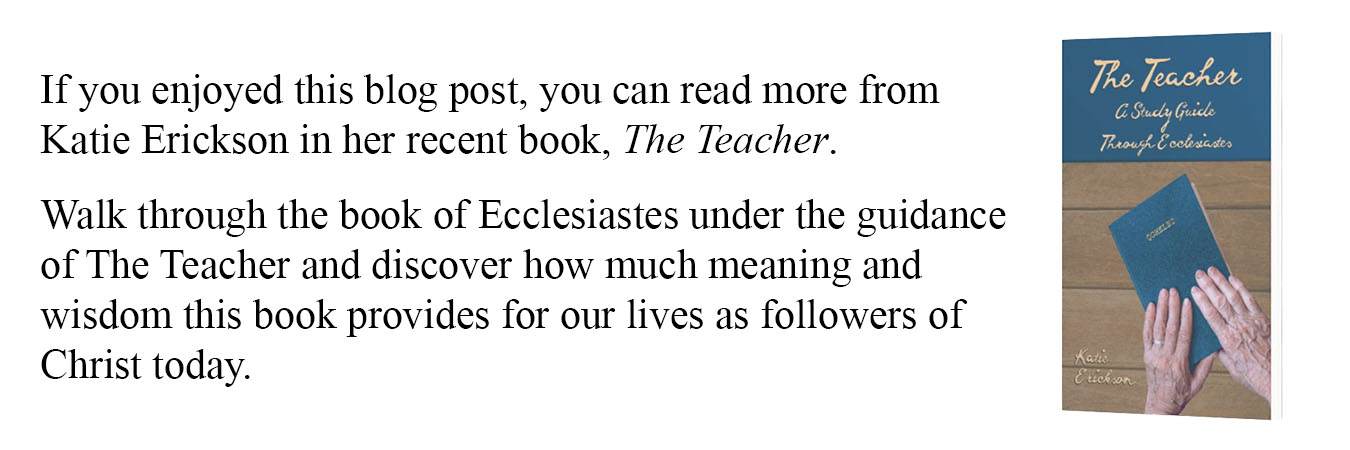
Just released today!! Check out this new resource by Katie Erickson:
This forum is meant to foster discussion and allow for differing viewpoints to be explored with equal and respectful consideration. All comments are moderated and any foul language or threatening/abusive comments will not be approved. Users who engage in threatening or abusive comments which are physically harmful in nature will be reported to the authorities.


I have written about the topic of the Bible’s authority in multiple posts over the years, and one can never emphasize this point enough. The Bible has authority, and everyone knows it, believer or not. Whether people recognize it or not, nearly every decision must go through the Bible and God’s revealed moral statutes. Those who believe and follow the Bible will make their decision based on a particular command or principle established in Scripture. Those who reject the Bible may not think about it actively as they make their decision, but they categorically rejected the Bible a while back. To this day, I have never met a person who can truly demonstrate that he rejects the Bible for intellectual reasons. He hides behind such reasons, but that is not why they reject it. It is because of the moral standards and the ever-present condemnation that it brings to men who are not of Christ.
The Bible has authority. One thing I find fascinating is that everyone who holds to some teaching that goes against what the Bible said, even if they proclaim to be Christians, are constantly arguing and debating against people who do believe what the Bible says. Why would they? The answer is very simple: they need approval from those who know God to justify their own unbelief. They are very clever in their approach, but they are constantly looking for acceptance and approval from the genuine believer. They would not do this unless they knew the Bible actually has the authority on the matter and they knew that the believer was at the watch tower to let them in or not. If they really believed the Bible didn’t have such authority, they would not even bother with us and they would not seek to get us involved in their choices. But they can’t escape it. God won’t let them live in rebellion against Him that easily. So they come to us for the purpose of seeking to suppress the truth and justify their unbelief and sin.
The Bible has authority. If you pay attention to any of the creeds or confessions of the faith of church history, the Bible is always what they start with, because the Bible is the source of all their information and their statements. It is imperative that we give the Bible the position that God gave it. There are three positions of authority I am going to address in this post.
1) The Bible is our first authority. Many people tend to forget this one and leave the Bible as the last resort. However, the Bible should actually be our first authority. It should be the first authority that we turn to. The Bible should be our first filter to determine what we should do. Any time we are confronted with a decision our first question should be “What does the Bible say?” (Katie Erickson’s book is a good primer on this issue.) The Bible may not explicitly state what we should do in every situation. It does not tell us whether we should go to that football game or not, or whether we can watch that show or not, or which school we should go to. But it does give us the framework we should use in making said decisions. One question we should use in such cases is: “How will doing this thing or going to this place help me give glory to God?”
The Bible teaches us that our primary purpose is to glorify God and to worship and enjoy Him. When God rescued Israel from slavery in Egypt, He didn’t want to just get them out of slavery; He wanted them to be a people unto Him, to serve Him and to glorify Him. The same is true when Jesus delivers us from the slavery of sin. Our saved life is about glorifying and serving Christ. So, when we decide what job to take or what school to go to or whatever, our first authority should be to see what God says about such things.
2) The Bible is our final authority. Now, don’t get the wrong idea here; I am not talking about the Bible being our last authority after we have exhausted all others. There are severe dangers in that because we’ll start getting ideas from the bad sources and intentionally or not, we’ll start comparing the Bible to what we heard from the world or start mixing and matching what the world says with what the Bible says.
What I mean by the Bible should be our final authority is that we should start with the Bible, do our study and analysis, and then check our conclusion with the Bible. We build our framework for our question with the Bible, and then we confirm that our answer, our models, and our conclusions still agree with the Bible in case we got off track. Many people will build their models and ideas and they’ll use pieces of Scripture to build them, but they never check to see if their models actually agree with what the Bible says. That is why we must check our ideas out with the Bible as our final authority.
3) The Bible is our ultimate authority. This is not popular today because this means that the Bible is above every other authority out there; yes, that includes all academics and modern “science” which has become its own religion. It does not matter how many physicists, geologists, astronomers, paleontologists, biologists, chemists, theologians, or whatnot support whatever model; if it does not agree with the framework of the Bible, namely the historical context of events it describes (6000 years of history, a global flood, and people dispersion from Babel), then it is not an accurate study. The skeptics hate the “statement of faith” that groups like Answers in Genesis or the Institute for Creation Research have in which any scientific statement that disagrees with the Bible must be wrong. At least AiG and ICR are up front about it. The same skeptics automatically dismiss any science that might agree with the Bible, so they are guilty of the same thing. But what many Christians have done, including some who are very good preachers otherwise, is surrendered the Bible in light of “modern science.” All the “old earth creation” models actively reject the authority of Scripture on this topic, whether anyone recognizes it or not, because in order to get “millions of years” into the picture, you have to reject Genesis’ account, even if you support pieces of it. It’s all or nothing.
A common argument I get is that “The Bible is silent on this issue; therefore, we are free to look to other sources.” Actually, no you are not. And you will find that the people who say the Bible is silent on the “age of the earth” have the exact same argument structure and style as those who say the Bible is silent on “loving, committed, homosexual relationships.” In fact, the Bible is quite clear on both of those topics. If old earthers had not brought such arguments into the Church, the Church would not be listening to it from the sexual immoral people trying to justify their lusts. Yet they are, because they no longer believe in the Bible as the ultimate authority, the supreme authority, and the superior authority. They didn’t go to it first. They went to their own models and own ideas. They did pull from some Scripture, attempting to justify their models by twisting Scriptures totally out of context. And they never went back to verify their models to compare them with what Scripture says.
If we are to actually believe the Bible as the inspired Word of God, as actually coming from God, we cannot allow any other authority to have a say. If we do allow them say, then they must be completely subservient to Scripture. Rank them. If the Bible is at authority #1, then science should actually be about #10 if not lower. In between with a full visible gap between the Bible and the next ranked authorities, pastors and commentaries should be next around authority #5 or 6. There should be no #2-4 in this case to just to showcase how far above and beyond the Bible is over any man and his sayings or writing. Even the man who fully believes the Bible should be put far below Scripture itself. Please, friends, don’t ever think that what I am writing here is actually remotely on par with Scripture itself. All I can do is point to it.
When we have the Bible in its rightful place with authority over all matters in which it speaks (hint: it speaks on every type of topic so there is no thing you can address in which the Bible does not have some say on the matter in concept, overview, or specifically), then we can make the wise and correct decision in any matter or situation. Over the next few weeks, we’ll look at how people are reading the Bible wrongly today and how it should be read instead.

This forum is meant to foster discussion and allow for differing viewpoints to be explored with equal and respectful consideration. All comments are moderated and any foul language or threatening/abusive comments will not be approved. Users who engage in threatening or abusive comments which are physically harmful in nature will be reported to the authorities.
by Steve Risner

Last week, we introduced Dr. Mary Schweitzer and her discovery that gained her a great deal of notoriety. Some 20 years ago, Dr. Schweitzer had found very well-preserved soft tissue remnants in a Tyrannosaurus leg bone. She and many others of the day refused to believe it due to the common understanding and scientifically verified reality that soft tissue will degrade into an unrecognizable form in several thousand or, in ideal conditions, perhaps a few hundred thousand years. These fossils were believed to be 68 million years old. Since that time, Dr. Schweitzer has discovered more soft tissue remains in fossils that are allegedly nearly 200 million years old. Others have found similar things in tube worm fossils that are believed to be over 500 million years old. Studies have confirmed that soft tissue will generally break down over a relatively short period of time, so these findings shocked the scientific community.
As I stated last time, Dr. Schweitzer is a believer. I’m happy that she has found her Savior and believe her sincere desire is to serve Him. I just believe, when it comes to her beliefs on origins, that she is wrong. This belief comes from my knowledge of the Bible which clearly teaches what she believes on origins is incorrect. I’d like to delve into some interviews she’s done to explore more of what she thought about what she had found.
In an interview, Dr. Schweitzer spoke with Emily Ruppel. I quoted her in my last blog post and wanted to finish discussing that before we moved on to her next statement. She said, “I think the thing that surprised me most about that class was that I had no idea, coming from a conservative Christian background, that scientists are not all trying to disprove God in whatever way they can.” I thought it was strange she was insinuating that conservative Christians are ignorant about things related to science. Some are, of course. Many different groups of people have smaller subsets within their groups that are not versed on a variety of topics. But to suggest that it’s normal for conservative Christians to be in the dark about science is preposterous, especially when we consider many of the greatest minds science has ever known were Bible believing Christians. I wrote briefly on that in this blog post. It’s a common misconception.
I stated last time that I was prepared to hear the humanist origins myth when I went to school. I had read a variety of books on it, had teachers who loved to push it, and mused over it quite a lot. I tried to see if I could fit what I was being told in my college and doctorate level science courses (that were related in some way) with what I knew the Bible said. I tried for some time to do this. It doesn’t work. Anyone that tells you it does is fooling themselves and/or trying to fool you.
Immediately after the above statement in her interview, Dr. Schweitzer says, “What we were not told growing up is that there’s a lot of very rigorous, hard science that allows us to interpret the lives of organisms we’ve never seen—and knowing this made me rethink a few things, because I know God and God is not a deceiver.”
This is important for two reasons. The first reason is it goes back to exactly what I said earlier—that she wasn’t prepared. She admits she wasn’t told about how science works and what scientists do. Scripture tells us in Proverbs 22:6 and Ephesians 6:4 that we are to raise our children in the fear and knowledge of the Lord and when that child grows, he will not depart from the path he was set on. I think a proper education in this manner would include knowing what the world says and why it’s wrong. But the last thing she says is very important: “…I know God and God is not a deceiver.” This is profound and the implication is exactly the opposite she wants it to be.
God has clearly stated how and when He created in His Word. There could hardly be a more plainly given communication on the matter. Fallen man, who has been in rebellion against God since shortly after his creation, has invented a story based loosely on some data as he looks at a cursed creation. That story is told by many to replace the Creator—this is a fact. Many who adhere to the Big Bang and universal common descent do so because they want to explain existence without God. It’s the whole point for some of them! Far too many believers have decided it’s okay to follow these God-denying rebels down that path. They claim “God is not a deceiver” but fail to recognize that, while this is true, they make Him into a liar with their beliefs in the humanist origins myth. If I have to choose between accepting the clear teaching of the Bible on a topic or the ever-changing, currently popular story told by humans who know very little in reality, I’m going to choose the Word of God every time. How could you be a believer and not choose this way? Man is so arrogant to think he knows better than the Lord—the one who created it all. The hubris is astounding.
There is a long list of things where God says one thing and humans say another. I choose to believe God in those matters. The world says life is a just a chemical reaction and has no real meaning. God says humans are created in the image of God and He has a purpose for each of us. The world says a baby in the womb can be slaughtered up to the moment of birth; it’s just a glob of cells. God says He knew us before we developed in the womb and, again, humans are created special in His image. The world says do whatever you need to get ahead. God says don’t lie or cheat, and work hard. The world says men can have babies. God says that He created them male and female, and I find no other genders mentioned. The list goes on and on. I choose to accept and believe what God has told us rather than what humans have decided. Dr. Schweitzer was forced to choose between believing God Almighty and the creation narrative or believing humans and the humanist origins myth. I believe she chose poorly.
The good doctor goes on to say, “If you step back a little bit and let God be God, I don’t think there’s any contradiction at all between the Bible and what we see in nature. He is under no obligation to meet our expectations. He is bigger than that.”
How someone can read the Bible and say there is no contradiction between Genesis and universal common descent, I have no idea. I’ve been a student of the Bible my entire life. I’ve taken more science courses than I care to recall. I find the tale woven by evolutionists about abiogenesis and universal common descent has no place in the Word of God. There isn’t a single Scriptural reference to support it. Deep time is similar. There is a very clear timeline outlined in Scripture as to when God made Adam – day 6 of creation. Genesis says God called life out of the earth and seas and it was so—animals after their kind were there. There is no mention of universal common descent over eons of time.
A person who claims there is no contradiction between the Bible and universal common descent has no idea what they’re talking about, or they do know and are lying. No rational and honest person can read Genesis and make such a crazy claim. I don’t mean to be so harsh, but it’s preposterous to say such a thing. She’s right—there is nothing in nature that contradicts the Word of God. But the way humanists have chosen to interpret the data is in stark contrast to the Bible. We don’t see universal common descent in nature. We simply do not. We see life. We don’t see evolution (meaning universal common descent from single common ancestor). She’s swapped what we see—life coming from life and small changes taking place do to a variety of reasons—for what we’ve never seen either in real time or the fossil record—life slowly morphing from one type of organism into something different.
It's very common—far too common—for people to say “science” when they mean their interpretation of the data. Sometimes, I suppose, this works but in the case of universal common descent, it clearly does not. Universal common descent is something that cannot be confirmed and has never been observed either in real time or the fossil record. The common saying by evolutionists is, “Evolution (meaning universal common descent and not just change) happens too slowly for us to see here and now but too quickly for the fossil record to capture it.” If this isn’t special pleading, there is no such thing.
We’ll continue looking at Dr. Schweitzer’s findings and what she thinks about her discoveries and how others view them in our next blog post.
This forum is meant to foster discussion and allow for differing viewpoints to be explored with equal and respectful consideration. All comments are moderated and any foul language or threatening/abusive comments will not be approved. Users who engage in threatening or abusive comments which are physically harmful in nature will be reported to the authorities.
If you’ve been following along in this series, do you ever feel like all the names of these kings of Israel and Judah tend to run together and get confusing? This week’s king definitely does not help that situation; he’s known as Uzziah in 2 Chronicles 26, but he’s known as Azariah in 2 Kings 15:1-7. The names are different in Hebrew as well as English, but we know it’s the same person because both are recorded as the son of Amaziah, and the chronology of the texts around them fits the timeline. Since there are more details provided about him in the 2 Chronicles passage, we’ll refer to him as Uzziah.
After Uzziah’s father Amaziah was assassinated, Uzziah was made king of Judah at the age of 16 years old. He reigned for 52 years. It’s interesting that 2 Chronicles 26:4 reports that, “He did what was right in the eyes of the LORD, just as his father Amaziah had done.” Amaziah started out his reign following God, but his downfall happened when he did not listen to God nor the advisors God had placed in his life regarding the battle with Israel. Would Uzziah follow that same pattern? The key to that comes in the second half of verse 5: “As long as he sought the LORD, God gave him success.”
King Uzziah gained a great deal of political and military power during his reign. He and the army of Judah conquered three main cities that were occupied by the Philistines. They also fought some nomadic Arab tribes that were inhabiting the southeastern part of Judah. Along with all of that, he built additional towers in Jerusalem and in various places in Judah. He was wealthy, with much livestock and many people working in the fields and vineyards for him.
During King Uzziah’s reign, Judah had a very strong army of more than 307,000 men that was also well-trained and ready for battle. They also incorporated the technology of the day into the towers that King Uzziah built in Jerusalem – shields were built into them so the soldiers could safely shoot arrows at incoming troops, and they also had mechanisms that sound similar to catapults, able to “hurl large stones from the walls” (verse 15).
Because of all this, King Uzziah became very powerful – and also very prideful, which was his downfall as a king. Verse 16 tells us that, “He was unfaithful to the Lord his God.” He went into the temple to burn some incense, but more than 80 priests followed him in and told him he should not do that. The duty of burning incense is only supposed to be completed by the priests who had descended from Aaron, not the king. They warned King Uzziah to leave; he had been unfaithful and God would punish him for that.
King Uzziah already had the censer in his hand to burn the incense, and he became angry at all these priests telling him to leave. Who were they to tell him, the mighty king of Judah, to leave when he wanted to stay and burn incense? While he was expressing his anger to the priests, leprosy suddenly broke out on his forehead! When everyone realized that, they quickly got King Uzziah out of the temple.
“King Uzziah had leprosy until the day he died. He lived in a separate house — leprous, and banned from the temple of the LORD. Jotham his son had charge of the palace and governed the people of the land” (verse 21).
Isaiah the prophet was alive during King Uzziah’s reign in Judah. As reported in Isaiah 6, it was around the time of King Uzziah’s death that Isaiah had a vision and was commissioned by God to be a prophet. Isaiah was a prophet during the reign of the 3 kings of Judah who followed Uzziah, and we know from his prophecies and from the historical accounts that even though King Uzziah started out doing what was right in the eyes of the Lord, he did not remove all of the idol worship from Judah.
Uzziah did great things for the nation of Judah – as long as he followed God. He captured cities and drove out enemies. He strengthened the army and therefore the nation as a whole. But then he got too big for his britches and thought he was invincible and could do whatever he wanted. Even when the priests warned him not to burn the incense since that would go against God’s rules for the temple and the people, Uzziah got mad and did not make any motions to stop proceeding with burning the incense.
Sometimes, God’s judgment can take a while to show up in our lives. Other times, like King Uzziah, it can be immediate. He was afflicted with leprosy right on the spot as punishment for starting the process to burn incense that was only for the priests. The leprosy never went away for him, and he lived the rest of his life with it. He had to give up ruling as king, even while he was still alive. The time period for that is debated, but some scholars believe it was about 14 years!
As punishment for his prideful actions, King Uzziah not only had to deal with leprosy and all of its symptoms, but he had to watch his son take over and be king instead of him. God saw that King Uzziah had too much pride, and dealing with all of that would definitely have to increase his humility!
Pride is a great sin before God, and it’s an easy one for us to fall into when things are going well for us. We gain confidence in ourselves and take our focus off of God and what He has done and is doing for us. We think it’s through our own skills or talents that we are prosperous, rather than realizing that it is all God’s doing – and God can take it all away in a moment if He chooses to do so. As Proverbs 16:18 says, “Pride goes before destruction, a haughty spirit before a fall.”
Watch out for pride in your life, or be prepared for God to humble you!

This forum is meant to foster discussion and allow for differing viewpoints to be explored with equal and respectful consideration. All comments are moderated and any foul language or threatening/abusive comments will not be approved. Users who engage in threatening or abusive comments which are physically harmful in nature will be reported to the authorities.
One of the greatest unfortunate side-effects of modern academia is that because it is based on man’s ideas and man’s interpretations, even the most elite scholars have actually forgotten the most fundamental thing behind academics: reading. Now, I am not saying that these people do not read at all, but that they do not know how to read. They know how to make ideas fit with their ideals, but do not know how to actually let a text say what it actually says. This is especially true when it comes to the Bible and Christianity. And I am not merely talking about the world “out there” either. I am talking about professing Christians and defenders of the faith in our apologetic communities. When I hear some of these people talk about the Bible, I seriously have to ask, “Do you even know how to read anymore?” Because what they say the Bible says is nothing like what the Bible says. People want to boast about the salvation and sanctification of Christianity, but for the life of them they cannot figure out what the word “day” means in Genesis.
This has compelled me to write a series about how to read and understand the Bible. God’s timing is perfect, because I just completed a series about returning our homes to a Biblical structure and format, to be a place that God directs and owns and where it is a place of production and value, rather than a place of consumption and about self. How can we return to the old paths, how can we go back in order to go forward, unless we know what God is actually saying through Scripture? We need to get back to the basics, return to the foundations. There is nothing wrong with studying things academically, but there is something dreadfully wrong with how academia is done today.
This post will start a series about the fundamentals of how to read and understand the Bible. While I will at times throw in some “academic” terms, those are merely fancy words for things we normally do anyway. The Bible is a simple book in that even a child can read and understand; but it is also a deep book that the most learned scholar will have only scratched the depths of its richness. And one thing I will make clear: if the “deep” meaning contradicts in any way the “simple” meaning, it is not a “deep” meaning at all but a perversion. I will not be as some of the academics that talk down to the non-scholars and say “you have to know the original Greek and Hebrew” to understand the Bible (which is useful, but not necessary), but I want to re-open the Bible to people. It is a book that is to be cherished, loved, and respected, but it is primarily meant to be understood, believed, and obeyed. If people want to reject the Bible, that’s their call, but they had better accurately represent it when they do so if they want to be known as an academic.
So, what is the Bible? What is this book? First off, it is not one book. It is a collection of 66 books written by 40 authors from all sorts of walks of life, in all different political and religious contexts, different locations, different languages, different primary audiences, different genres, all over a 1600-year span, and yet it all says the same message. It is not an anthology either, but it actually reads as though it is a single book with a single mind. There is no other book that is like it. No anthology compares. No academic text compares. No historical document compares. No religious text compares either. It is unique among all other books. You can get more details about this in my book Ten Reasons to Believe the Bible.
The Bible is not just a book of Jewish writings about the Jewish people, but rather a book by Jewish authors through whom God is sending a message to the whole world. The primary audience of the Bible is not Jews, but rather the Church throughout the ages. While many academics often look at the Bible from the lens of the Ancient Near Eastern culture, that is not an appropriate way to interpret it. Even though Israel was geographically in the Ancient Near East, culturally they were vastly different. God set up their culture to be different from the rest. This was to be a physical demonstration for the church age to come.
The Bible’s historical writings have a two-fold purpose. First, to give an accurate history. That history was primarily as a test to prove who the Messiah would be. Jesus had to come from Adam, Noah, Shem, Abraham, Isaac, Jacob, Judah, and then David. The historical records are not only the most accurate accounts of history ever written, but their accuracy is part of what enables us to know that Jesus is indeed the Messiah. Second, to give all its readers examples of every type of situation we could face. These are not myths nor fables but records of actual events. They actually happened as described. They were not mythicized. There are countless examples where I have seen the exact same tactics and moves used by the people recorded in the Bible today.
The Bible has laws, teachings, wisdom writings, songs, prophecies, parables, group and personal letters, apocalyptic literature, and even metaphors and allegories. The primary genre is history or historical narratives – giving an account of what happened. Unless the text demonstrates to be otherwise, this should be the default. I’ll deal with this more as the series progresses.
The Bible is unique from every other book in that it is inspired by God. While God did indeed use human authors to physically pen the text, each were moved and carried along by the Holy Spirit. In some cases, it was direct dictation such as the prophecy books. In other cases, the Holy Spirit utilized the author’s personality and writing style and yet still carried on the divine spirit in the text. Not just any book or author could claim this, though many tried. Moses and the Apostles in particular were validated as divine authors because they were given power to perform miracles that showed they were from God. The prophets were authors were tested by the tests of a prophet which included a death sentence for prophesying wrongly. So not only were these books written under the direct influence of the Holy Spirit, but they were publicly recognized as such at the time they were written. It is this inspiration that gives the Bible its position as the first, final, and ultimate authority over every matter it speaks on.

This forum is meant to foster discussion and allow for differing viewpoints to be explored with equal and respectful consideration. All comments are moderated and any foul language or threatening/abusive comments will not be approved. Users who engage in threatening or abusive comments which are physically harmful in nature will be reported to the authorities.
by Steve Risner
I’d like to look at interviews done by Dr. Mary Schweitzer, the famed paleontologist who received notoriety when she published her observations that she had found soft tissue in dinosaur fossils. She was not the first person to find soft tissue, but she was the first one to receive a great deal of attention for doing so.
In 2005 (or 2004 depending on the source), Dr. Mary Schweitzer published work on how she looked inside a fractured thigh bone of a Tyrannosaurus rex and discovered soft tissue still inside. Now, to be fair, the tissue wasn’t wet and spongy at the time, but it was intact. This is how Discover Magazine describes it: “…Schweitzer gazed through a microscope in her laboratory at North Carolina State University and saw lifelike tissue that had no business inhabiting a fossilized dinosaur skeleton: fibrous matrix, stretchy like a wet scab on human skin; what appeared to be supple bone cells, their three-dimensional shapes intact; and translucent blood vessels that looked as if they could have come straight from an ostrich at the zoo.” This sample was dated by secular scientists to be about 68 million years old. Since then, Dr. Schweitzer has discovered soft tissue in samples alleged to be 145.5 to 199.6 million years old!
This created a variety of responses. Even Dr. Schweitzer’s initial response was one of denial. She said, in that same article in Discover about her first thoughts, “Uh-uh. This isn’t happening. This is just not happening.” Much of the world of paleontology rejected Dr. Schweitzer’s claims. This was because, in her own words, "If you take a blood sample and you stick it on a shelf, you have nothing recognizable in about a week. So why would there be anything left in dinosaurs?" Soft tissue cannot remain after such long periods. Some scientists at the time rejected the find outright, saying she must have had contamination in the sample. Some said she rushed too quickly to get her findings published and should have taken more time. While she agreed she was in a hurry to get her findings out there, in response to this she said, “That's the saddest part about doing science in America: You are totally driven by what gets you funding.” This is all too true in the world of science today. Money and notoriety drive many scientists. Obviously, a research team needs funding to do their work, but a scientist working for money or to please a donor is less likely to be objective or to allow the facts to lead them wherever they may, in my opinion. Politics dictates truth for us, I guess. But the point is many rejected Dr. Schweitzer’s findings and some even called into question her credibility. But over time, it became undeniable. Others found similar things and, while being denounced initially, her findings have been confirmed by several other labs.
This is all very interesting in the origins debate because we know—actual science has demonstrated very well—that soft tissue cannot remain intact for even a million years, let alone tens or hundreds of millions of years. It could easily remain for the 4400 or so years since the Flood. But research published in Science and Antiqua both suggest that soft tissue—mostly collagen—can possibly survive intact for tens of thousands of years. They have even suggested it might last for a hundred thousand years, but it cannot survive for millions of years. Sixty-eight million is absurd and the almost 200 million years in one find is outrageous. Even more unbelievable is the discovery of soft, still flexible tube worms found in rock layers said to be over half a billion years old! That’s approaching the “laugh out loud” level of crazy, in my humble opinion. There are many other studies out there that confirm this. So, the publishing of this discovery was quite the thing.
A short list of other soft tissue discoveries since Dr. Schweitzer’s that cast doubt on the belief in deep time are: a 10 million year old frog that is still soft and has blood in its marrow, whole salamander muscle tissue that is allegedly 18 million years old, live bacteria from 30 million years, DNA nearly 30 million years old, pigment structures from 36 million years ago, lizard skin from 40 million years, hadrosaur nucleic acids and skin cells dated at 65 million years, mosasaur blood supposedly 67 million years old, connective tissue in a Triceratops dated at 68 million years, blood vessels in a hadrosaur believed to be 80 million years old, live bacteria in amber dated at 100 million years, skin pigment dated to 125 million years, amino acids in insects dated at 130 million years, squid ink thought to be 150 million years old, ichthyosaur skin dated to be 190 million years, live bacteria in salt 250 million years old, crinoid pigment believed to be 350 million years old, shrimp soft tissue dated to be 360 million years old, and finally tube worm chitin claimed to be 551 million years old. Research suggests these structures may be able to last for possibly hundreds of thousands of years under very good and consistent conditions. A million years would be a major stretch. We’re talking about 10 to 500 times that! You can probably see why the evolutionary believers made such a stink over her findings.
Dr. Schweitzer is a believer, and I appreciate this about her. I do find her beliefs on origins to be at odds with the written Word of God, but I cannot make any argument with her salvation. That is between her and the Lord, and I find no reason to doubt it. I think her beliefs on origins are incorrect simply because she makes claims that are clearly contradictory to the Bible—especially the Genesis narrative. I wanted to explore her stated beliefs on this and how she explains her findings. I also wanted to note how she disparages those who have taken her work and used it to support the Word of God. We disagree, but I don’t think this makes her a bad person. I don’t think this makes her a bad Christian. I don’t think this makes her a bad scientist. I just think she’s wrong on this issue. I base this on the clear teaching of the Bible. You don’t need to be a scientist to understand this. Many, including Dr. Schweitzer, mistakenly equate science with their interpretation of their findings. A discovery doesn’t come with all the facts and how it should be viewed. Scientific data and a person’s interpretation of that data are two very different things. I’ve written on that quite a lot. Long ago. And also here. And maybe here. I wrote several posts on that between 2014 and 2016 among other times.
So, while I believe it’s fair to say that Dr. Schweitzer seems to be a fine person and she holds sincere beliefs, some of those beliefs are not in accordance with the very plainly and clearly written Word of God. Let’s take a look at a couple of interviews she did trying to explain why her discoveries of soft tissue that should have long been rotted away are in line with deep time and universal common descent. She does not believe these findings support the Bible and, in fact, she thinks people who are using her work to support their belief in the Bible are being dishonest.
Dr. Schweitzer says she grew up in a conservative Christian home. When she took certain classes in college, she was blown away by the contrast between what she believed at the time and what she was taught in those classes. She said in a 2014 interviews, “I think the thing that surprised me most about that class was that I had no idea, coming from a conservative Christian background, that scientists are not all trying to disprove God in whatever way they can.” What surprises me the most about this statement is she believes that being a conservative Christian means you’re completely ignorant on things related to science. This is basically a slap in the face to Christians who have put their faith and hope in the Word of God, in my opinion.
I grew up in a conservative Christian home. While I tried to reconcile my belief in the Bible with what I was taught in college and graduate level biology courses, what they told me never struck me as surprising. I was prepared. Apparently, Dr. Schweitzer was not prepared. I believe it’s very important to raise our children to understand what the Bible says and how we should look at it to understand it while also making them aware of the ideas the world has that may challenge our understanding of God’s Word. She seems to not have been made aware of these challenges. This is not an accusation at all, but it does mean that while she believes her experience was the “normal” one, it clearly is not the only option. There are many conservative Christians who have viewed the evidence for universal common descent and deep time and find it unappealing and unconvincing. Many of those hold degrees in biology, physics, astronomy, and other related fields. Her error stems from being misinformed or uninformed and being impressed with the secularist’s version of origins—the humanist origins myth.
I’ve just scratched the surface on these interviews related to the earthquake of a discovery published by Dr. Mary Schweitzer, and I’m out of space for this blog post. We will get much further into this next time. Thank you for reading, and I appreciate any comments you may have. Until next time, be blessed.
This forum is meant to foster discussion and allow for differing viewpoints to be explored with equal and respectful consideration. All comments are moderated and any foul language or threatening/abusive comments will not be approved. Users who engage in threatening or abusive comments which are physically harmful in nature will be reported to the authorities.

by Eric Hansen
Merriem Webster offers a few definitions for the word suicide. At its core, each definition is rooted in “destruction of oneself.” When people decide to act on this, most write a letter in some fashion outlining what led them to the decision. Due to the sensitive topic this tends to be, I will preface this now with I am not looking to follow this action. But, on a personal and (more importantly) hopeful message for anyone who is dealing with such considerations, let me explain how the significance of not committing suicide physically led to me doing so spiritually.
While I was in high school, I went through a lot of depression. I experienced much of what adults call “cliché emo(tions)” as a teenager, however real they felt to me at the time. Many times I thought of committing suicide. I remember to this day the vivid hold that I was once under. Everything was planned out and perfect, but something also kept telling me not to. It was a matter of seconds between go and no-go.
I was far from a Christian then in 2004. I was reading the Satanic bible, and I was a strongly-proclaimed agnostic. So to me, it wasn’t God trying to love me til the literal very end.
The connection to that and the present day is staggering as I think about these things under a new light. I can sit here, filling my lungs with the air God blesses me with, and say I’m both dead and alive. I committed suicide in a very real and direct way back in 2018 when I committed my life to Christ, and yet I am living a whole different life. There are a lot of similarities between surrendering your life to Christ and the normal view of suicide, as you’ll see below.
Matthew 16:24-26 is a very popular passage when it comes to understanding surrender to Christ and stepping away from your own desires for the betterment of the Kingdom. But there is so much to unravel with just those 3 verses.
“If anyone would come after me, let him deny himself and take up his cross and follow me.“
Back then, I didn’t want to deny myself. I’ll call a spade a spade and say I was egocentric in my thinking; I was only focused on my pain, hurt, and despair. I wanted to give in so much, yet at the same time I couldn’t. That was the most fearful part of the experience for me.
This is also one of the hardest parts of becoming a Christian for many, myself included, especially in the individualistic cultures such as America where it’s every person for themself. You have to learn to basically kill yourself; kill your desires to have control to really build that relationship with the Father.
That cross, no matter which scenario we’re talking about, is so unbearably heavy. I get why many people go through with it, but I also get why just as many don’t. Both of those nights, I slept the best in a long time. In both situations, no one knew any differently, that I was going through those thoughts, until I spoke about it.
“For whoever would save his life will lose it, but whoever loses his life for my sake will find it.”
To lose your life via physical suicide is ultimate. There is no going back from it when successful. Yet when we become Christians, we tend to only lose part of our life – our old self. Many still compartmentalize their faith and “let” God see parts but not the whole.
Looking back at it, I believe that when I contemplated suicide as a teenager was the first time in my life I felt God’s love just tearing into me to shine His sanctifying light into my soul. I continued to ignore the light for years to come, but He never left me no matter how much I ran away.
Now, as a Christian, the view is a little bit different. I was okay with dying from my old self to become new, but I didn’t know what that looked like. As one not brought up in the church, I felt like no one really understood the confusion I had no matter how I tried to explain it. What it finally took was just reading the Bible and long-night prayers that caused me to literally cry out to the Father.
“For what will it profit a man if he gains the whole world and forfeits his soul? Or what shall a man give in return for his soul?”
When you (try to) commit suicide, you’re forfeiting your soul to the reasoning of the action. For me, I was forfeiting to the thoughts that wouldn’t leave me.
When you surrender to Christ, you’re forfeiting your soul to Christ. For me, this is letting go of having control over everything.
I really wish I could say that the span of time between 2004 and 2018 was full of great discoveries, peace, etc., but very few moments come to mind. I went through some bad relationships before finding my soulmate and marrying her. The feelings of desertion from those who I thought were close to me only grew deeper. It truly wasn’t until 2018 when I started realizing what unconditional love meant. Yet it took even longer for me to realize what grace really is. It’s important to realize that Christ is so close to us that not only did He die and resurrect for us, but He did so to bring us in such a deep relationship with the Father. He took our sins upon himself on that cross, bleeding out in agony with his bones slowly breaking, out of love for the Father and us.
I saved my teenage life to continue living in a hell that had marginal improvements throughout, to end my old life and live anew. It wasn’t until I realized I needed saving that I also realized I already had a savior. Have you committed spiritual suicide through dying to yourself and allowing Jesus to save you?
This forum is meant to foster discussion and allow for differing viewpoints to be explored with equal and respectful consideration. All comments are moderated and any foul language or threatening/abusive comments will not be approved. Users who engage in threatening or abusive comments which are physically harmful in nature will be reported to the authorities.

