
After lashing out His final words against the Pharisees and the religious system that enslaved the people instead of setting them free, Jesus went out to the Mount of Olives, where He gave His disciples a glimpse of how things would end. Jesus really wasn’t giving a revelation of the final days of the earth, but rather of the church age. I can picture them looking down upon Jerusalem (from on top of the mountain) at this time, with Jesus knowing that the difficulty they have had with Rome up to this point would be nothing compared to what was coming for them. The disciples were intrigued by Jesus’ statement about the end of the religious system there and sought more details.
Jesus emphasized two things: the end of all things would be imminent, so live as though He would be returning today. The other is that you will see signs, but the end is not there just yet, so prepare for a long marathon. Remember that Abraham was given promises that weren’t fulfilled for 2000 years. It has been 2000 years since Christ was here on earth. That doesn’t mean there won’t be another 2000 years or whatnot. I can say that every generation has thought Jesus would return in their lifetimes, and it definitely looks closer today than it has ever been before. And in reality, it is closer today than ever before, but it still may be a while off. I will also say that whatever happens in or to the US might be completely irrelevant to end-times prophecy. Many believers in Europe may have thought the same thing about their nations as Christianity gave way to Communism or now to Islam and left-wing liberalism. So, what did Jesus actually say about the end times?
Jesus spoke about natural disasters. There would be earthquakes and disasters on the increase. Earthquakes have been going on ever since the Flood, but it hasn’t been until the last 150 years that we’ve kept track of them worldwide. So far, there have been five recorded 9.0 quakes or stronger. One in Chile, one in Russia, and one in Alaska in the 1950s and 60s. But the other two have happened since the 20th century: one in Indonesia in 2004 and the one in Japan in 2010. These quakes would increase in frequency and in intensity, and earthquakes are a common natural phenomenon during the Seal, Trumpet, and Bowl judgements of Revelation. But earthquakes aren’t the only natural disaster accounted for here, and as I am writing this, Texas was recently hit by severe flooding. All these things should remind us that the day of Jesus’ return is coming soon.
Jesus spoke about wars and rumors of wars. The 20th and 21st centuries have seen more wars than all over centuries combined. And the wars have gotten uglier and uglier as our weaponry has improved and our morals have gone down. While a proper declaration of war really hasn’t taken place since WWII, military operations have been at an all-time high, and instead, we have this spy game type thing of operation after operation, but no formal war has actually been declared. But violence has spiked, and it hasn’t capped yet. The US was the safest nation for 200 years, but now it is hard to find towns where you can actually leave your doors unlocked without worries.
Jesus also gave a warning about false Christs. These would come in droves. And Jesus was not talking about anyone who claimed to be the Messiah. I’ve seen and encountered a few such people, and they are either on drugs or demonically influenced. But that’s just the big scale. There have been many false Christs and false Jesuses, and the most frequently seen one is the Jesus that is a figment of one’s imagination – a “Jesus” that contorts and fits any mold we make for him and does what we like, hates what we hate, and looks a lot like us. And just as the Golden Calf was called “Jehovah,” there are a lot of false gods that are given the name of the True God out there. These are gods whom people deem to be powerful, but do not have sovereignty. Therefore, they cannot be a god if they are subject to human will. We must be diligent and vigilant, always on guard, because the deception is only getting stronger and stronger.
But after all these things, the second coming will be swift and sudden. After a long time of doing normal routines, Jesus will come with such speed that there will be no time to get things ready. It will be like a thief in the night. He doesn’t come unless he knows your guard is down. Jesus is not going to come when anyone thinks He is going to come. If some guy tries to put a date on things, don’t believe him. If another says Jesus is a long way coming, don’t believe him. There is urgency in this message, and if there were no urgency in Christ’s return, evangelism would not happen, and Christians would be sitting around, just being comfortable while the world burns. But there is urgency, and “today” is the day for salvation because there may not be another. At the same time, there is a delay in His coming. Jesus is waiting for all those who could be saved to be saved before closing the door.
The status of Jesus’ coming is going to be like Noah’s Flood. People will be going about their regular lives with no care or regard for God, when it will suddenly hit. Now, in Noah’s time, some finally listened and realized that Noah might be right, but they would have sought to save themselves in their own way. They perished, too. But the majority will not have a clue until the time of, and then it will be too late. Only this time, there is no physical ark to bang on the door. When Jesus comes, judgment day will come, the believers will be gathered together, and the unbelievers will be scattered. We’ll address that next week as Jesus gives three parables that illustrate what waiting for Him and believing Him looks like and what not believing Him also looks like.

This forum is meant to foster discussion and allow for differing viewpoints to be explored with equal and respectful consideration. All comments are moderated and any foul language or threatening/abusive comments will not be approved. Users who engage in threatening or abusive comments which are physically harmful in nature will be reported to the authorities.


By the humility and gentleness of Christ, I appeal to you—I, Paul, who am “timid” when face to face with you, but “bold” toward you when away! I beg you that when I come I may not have to be as bold as I expect to be toward some people who think that we live by the standards of this world. For though we live in the world, we do not wage war as the world does. The weapons we fight with are not the weapons of the world. On the contrary, they have divine power to demolish strongholds. We demolish arguments and every pretension that sets itself up against the knowledge of God, and we take captive every thought to make it obedient to Christ. And we will be ready to punish every act of disobedience, once your obedience is complete.
- 2 Corinthians 10:1-6
After spending the last two chapters discussing the theme of generosity, there is an abrupt change in Paul’s letter to the first-century church at Corinth as we begin chapter 10. He begins a defense of his ministry and discusses that the battle we fight as Christians is not in the physical realm but the spiritual one.
Paul begins this section in verse 1 with a tone of humility and gentleness, qualities modeled after Christ. By invoking "the humility and gentleness of Christ," Paul appeals to the church not with harshness or anger but with the same tender spirit that Jesus demonstrated. This sets the tone for the rest of his message, focusing not on confrontation but on correction.
Paul acknowledges the criticism he has received—some in Corinth accused him of being bold and authoritative in his letters but timid when present with them in person. This accusation implies that he is inconsistent with how he presents himself, something that Paul's critics used to undermine his authority. Yet, Paul embraces this criticism, not denying the perception but turning it around by using humility as a strength rather than a weakness. He contrasts worldly power, which relies on force, with the Christlike power he embodies—gentle and humble, yet deeply authoritative because it is rooted in spiritual truth. Humility and gentleness are often misunderstood as weaknesses, but Paul demonstrates that they are central to Christian leadership.
In verse 2, Paul prepares the Corinthians for potential rebuke if necessary. He hopes that when he visits, he will not need to be bold or confrontational but can instead engage with them gently. However, he makes it clear that he will address those who believe he operates according to the world’s standards.
Some people in Corinth were apparently accusing Paul of being worldly or operating out of worldly motivations, perhaps criticizing his style of leadership or his unwillingness to conform to societal norms. Paul reminds them that his authority and methods are spiritual, not worldly, and that his boldness, if necessary, will be directed toward those who refuse to see this. Sometimes boldness is necessary, but it must be reserved for situations where spiritual truth is at stake. Paul’s boldness is never out of personal pride but out of a desire to defend the truth of the gospel.
In verse 3, Paul shifts the focus to a key theme in this passage: spiritual warfare. Although Christians live in the world, we do not engage in battles as the world does. This implies that the strategies, tools, and methods of the Christian life are not those of worldly power, politics, or human strength. In the world, battles are fought with physical weapons and human strategies. But Paul emphasizes that the Christian life involves a deeper, spiritual conflict. Our struggles are not against people or institutions, but against the spiritual forces that stand in opposition to God's kingdom. This verse is a powerful reminder that the Christian life is fundamentally different from the world’s way of living. We are often tempted to rely on worldly solutions—status, wealth, power, influence—but Paul points us to the reality that our true battle is spiritual.
Paul continues this contract in verse 4, making it clear that the tools of spiritual warfare are entirely different from those used in worldly conflicts. The "weapons" he refers to are spiritual weapons, empowered by God Himself. These weapons include prayer, the Word of God, faith, righteousness, and truth—things that may seem weak by the world’s standards but have divine power.
These spiritual weapons are potent enough to demolish "strongholds." A stronghold is a fortress or a place of defense. Spiritually, strongholds represent anything that exalts itself against the knowledge of God, such as false teachings, sinful habits, and ideologies that oppose the truth of the gospel. Often, we may feel inadequate or ill-equipped to face challenges because we are looking for worldly solutions. But God equips us with weapons that are far more powerful than anything the world can offer.
Paul continues by explaining how these spiritual weapons work—they destroy arguments and lofty opinions that oppose the knowledge of God (verse 5). The battle is not merely external but also internal. Paul emphasizes the importance of taking every thought captive, making it obedient to Christ. This means that the battle often starts in the mind. Arguments, ideologies, and false beliefs must be confronted and demolished, and every thought must be brought into submission to Christ’s truth.
Paul’s instruction highlights that the Christian’s greatest battlefield is often within their own mind, as they strive to align their thoughts with the truth of the gospel. Taking every thought captive is a practical and ongoing process in the Christian life. We are constantly bombarded with thoughts that may lead us away from the truth. By discerning these thoughts and surrendering them to Christ, we can grow in spiritual maturity.
Paul declares in verse 6 that once the Corinthians have fully obeyed the truth, they will be in a position to confront and deal with disobedience. His desire is for the Corinthians to reach full obedience so that the church can maintain spiritual purity and discipline. Paul is not referring to punishment in a vindictive or punitive sense, but rather to the correction that comes after obedience is established. He wants the church to be in a position where they can uphold truth and address issues of disobedience with a clean heart and pure motives.
Obedience to Christ is not just a personal matter but has implications for the whole church. When we walk in obedience, we can help others do the same. Paul’s call to address disobedience after obedience is a reminder that spiritual growth leads to greater responsibility in helping others follow Christ.
This passage encourages us to confront others not with arrogance or superiority but with the same humility that Christ exemplified. It is important to balance gentleness with the necessary boldness required to uphold the truth, rather than compromising the gospel to avoid confrontation. Our battle is not with each other but in the spiritual realm, to tear down the strongholds in our lives that keep us from God. We must take every thought captive to strive toward becoming obedient to Christ. Our strength comes from God, not from this world.

This forum is meant to foster discussion and allow for differing viewpoints to be explored with equal and respectful consideration. All comments are moderated and any foul language or threatening/abusive comments will not be approved. Users who engage in threatening or abusive comments which are physically harmful in nature will be reported to the authorities.
When we preach the Gospel, we need to understand that while it is great good news for the salvation of man, it is also a grave scandal. Many people trip over the Gospel, and they DO understand the scandal. They know they are sinners, but for Jesus to die for them is unfathomable. And it’s not merely Jesus dying out of love for us that trips them, it is more specifically Jesus taking on the wrath of the Father for sin upon Himself that trips them. If it was merely Satan carrying out the execution, some may not object, but the actual executioner of holy judgment is by God the Father.
This gives rise the argument of “Cosmic Child Abuse.” Dad got mad at his kid and took it out on the dog. That’s what some have said. How can God be called good and kind and loving if He takes out His anger on His own Son? The Gospel is a scandal. In order to save mankind, there had to be a substitute who had no sin Himself, because the righteous justice of God has to be met. God is not going to let any evil go by without dealing with it. And that is what many objectors to Christianity do not like; they know their deeds are evil, and the mere mention of a righteous and holy God offends them because it means that their judgment day is approaching.
This message is very unpopular. Emile Ramos, James White, and Paul Washer did a 30-minute joint video titled “Unpopular” emphasizing that the Gospel message is not going to please many audiences, because the core of the Gospel message is that man is sick, depraved, and completely helpless. And after salvation, man is still useless, weak, frail, and completely and wholly dependent upon Christ. People mock Christianity because we “use Jesus like a crutch.” I correct them: “No, it’s not like a crutch. It’s more like life-support.” The Gospel is because we are dead without Jesus. That’s not going to win over many crowds.
Paul was given an opportunity to speak to the intellectual of intellectuals at Mars Hill in Athens. If he were interested in winning a crowd over and getting people on his side, there was no better opportunity. He had just been driven out of two consecutive towns in Thessalonica and Berea for preaching the Gospel and was sent ahead to Athens to try to cool down and let the people cool down. And Paul, alone, waiting for his team to come join him, got provoked. He saw the idolatry in the streets, and he could not wait for backup. He began preaching. When he gave his famous defense at Mars Hill, Paul did the last thing he could have done to win the crowd over. While he did reference the religious idolatry of Athens, he basically went in and said, “You are doing everything wrong and don’t even know who you are worshiping or why. Here is the true God and how His worship should be done.” Paul had to sweep the rug from under them and plant a new foundation so he could go to his destination: Jesus and the cross. And the audience lost it the moment Paul spoke of the resurrection. Most mocked, some wanted to hear more, and only a few individuals believed.
The Gospel is not going to be well-liked. If you want approval, praise, and the rapport with men, that may be all you will ever get, and you will have renounced Christ in doing so. Most won’t like the Gospel message delivered correctly. Our job is to preach the Word, even if no one receives it. As Christians, our job is to share the faith, even if no one will hear it. And the church took a major turn off the main road when they decided that their numbers were not good enough and so they decided to pursue “seekers” instead of pursuing God. Instead of giving the unpopular message that God gave us to give, they chose to go for popularity and the approval of sinful, wicked men. There is a severe problem with this: sinful men do not want God, not as He truly is. So to keep sinful men around, they church had to change God. Instead of being the sovereign, righteous king who is coming back to judge the wicked and rescue the righteous, “God” became just a nice, fuzzy blanket to keep you warm in front of a fire. It’s truly blasphemous what most have done in their depiction of God.
And when Christendom as a whole goes that direction, when the few people who still stand for the true God and the true message, we are the ones who get ostracized for rocking the boat. I see it happening very often. I’ll say the hard thing and the backlash is quite sharp. It does not matter how much “love” or “tact” I give it. It is rejected, and the problem is “me” because what I say is not letting “them” play this game they call “Christianity,” a game that God does not play.
There is one detail about the Gospel message that drives it to such an unpopular level: the denial of self. When we receive the Gospel, we are admitting that we have nothing in and of ourselves that is good that we can bring to the table. Getting us to that point requires us to acknowledge that we never had anything or ever will have anything good in us. Before Christ, we had nothing to start with. After, any goodness we have comes from Christ, not us, even in our regenerate spirit. And even harder to receive is that to be a Christian, it is going to cost us everything – not merely our sinful lifestyles of doing bad things, but everything. Jobs, finances, family, friends, hobbies, entertainment, sports, your education, your reputation, everything is secondary or less compared to Jesus.
Paul was the intellect of intellects, the Benjamite of the Benjamites, the most zealous upholder of the law, and when he met Christ, he saw everything he was pursuing as total dung, worthless, rubbish. He scrapped everything and started over with Jesus as the #1 and as the center. He still learned and knew many other things, but they had a new focus and a new place in their value. His faith in Christ cost him a LOT, and throughout his missionary journeys, his greatest enemies were the Jews – those who knew who he was and deemed him a total traitor. There is a cost to being a Christian. There is also a cost to proclaiming the faith. And one thing you cannot have with the truth is friendships with those who oppose it. Something has to go; it is your choice which.
The Gospel is an unpopular message. Next week, we’ll look at different ways the Gospel has been watered down and diluted so it will be more “acceptable” to sinful man.
This forum is meant to foster discussion and allow for differing viewpoints to be explored with equal and respectful consideration. All comments are moderated and any foul language or threatening/abusive comments will not be approved. Users who engage in threatening or abusive comments which are physically harmful in nature will be reported to the authorities.
So will it be with the resurrection of the dead. The body that is sown is perishable, it is raised imperishable; it is sown in dishonor, it is raised in glory; it is sown in weakness, it is raised in power; it is sown a natural body, it is raised a spiritual body.
If there is a natural body, there is also a spiritual body. So it is written: “The first man Adam became a living being”; the last Adam, a life-giving spirit. The spiritual did not come first, but the natural, and after that the spiritual. The first man was of the dust of the earth; the second man is of heaven. As was the earthly man, so are those who are of the earth; and as is the heavenly man, so also are those who are of heaven. And just as we have borne the image of the earthly man, so shall we bear the image of the heavenly man.
- 1 Corinthians 15:42-49
Just before this, Paul began to address what our resurrected bodies will be like. In that passage, Paul established that our resurrected bodies will be different than our earthly bodies but yet mde from similar material. Here, he elaborates on that a bit, through we as humans still do not know many details of our resurrected bodies.
Verses 42-44a calls out three characteristics of our natural, earthly bodies: they are perishable, dishonorable, and weak. In contrast, our supernatural or resurrected bodies will be imperishable, glorious, and powerful. This verse continues the metaphor from the previous section about how a seed that is sown must die before it is “raised” as a new plant. The seed and the plant are similar substances yet also very different, and the same is true with our natural bodies versus our super natural bodies.
Philippians 3:20-21 also illustrates this transformation for us: “But our citizenship is in heaven. And we eagerly await a Savior from there, the Lord Jesus Christ, who, by the power that enables him to bring everything under his control, will transform our lowly bodies so that they will be like his glorious body.” Our lowly, natural bodies will undergo a transformation as we go from natural to supernatural, from physical to spiritual. Jesus Christ has the power to make that transformation happen for us.
These contrasts help us see that there will be definite differences between our natural or earthly bodies the we possess today and the the supernatural, spiritual, resurrected bodies that we will experience one day in heaven. Jesus has brought immortality to those who follow Him, as referenced in 2 Timothy 1:10.
The last part of verse 44 states, “If there is a natural body, there is also a spiritual body.” When Paul says that our resurrected bodies will be ‘spiritual,’ he is not meaning that we won’t have bodies in some way and exist only as spirit. But our ‘spiritual’ bodies will be different and have different functions than our earthly bodies. They will be bodies that can last for eternity and are given to us by God Himself.
These disctinctions are discussed more in the rest of this passage. In verse 45, Paul develops a contrast between two categories – the first Adam and the last Adam. Paul has used this contrast before, specifically in Romans 5:12-21. There, he talked about how sin and death came through one man (Adam) but life came through another man (Jesus). Here, he references the creation of Adam’s body in Genesis 2:7 in contrast to how the last Adam (Jesus) possesses a life-giving spirit.
Paul continues in verse 46 by stating that the natural came first and then the spiritual. While the account in Genesis 2 shares that God created Adam’s physical body before breathing the breath of life into his nostrils, this more likely refers to the spiritual body that will never die once a person receives eternal life. There will be some kind of transformation that occurs in our bodies, because our new, spiritual bodies will never become corrupt like our current, earthly ones.
Paul continues his contrast between Adam and Jesus by sharing their differences in creation. Adam was created from the dust of the earth, while Jesus was “of heaven” (verse 47). Jesus was not created, as He is God and has existed in eternity past. But when He came to earth as a man, He came from heaven. The Greek preposition used there could mean of, out of, from, etc.
This world that God has created is one of order, and following that principle, all people who are on the earth are of the earth, and those who are in heaven are of heaven (verse 48). We do not know exactly what that means, other than the continuing contrast Paul is making between earth and heaven. There will likely be some similarities, but our heavenly bodies will be different than our earthly bodies, just as heaven is different than the earth.
Finally, Paul wraps up this contrast by focusing on the image that we bear as humans in verse 49. The word used for ‘image’ there is the same word that’s used in Genesis 1:26 in the Greek translation of the Old Testament. Just as we are created in God’s image on earth, we will also exist in God’s image in our heavenly bodies.
We do get some further insight into what our resurrected bodies may be like when we look at the accounts of Jesus appearing on earth after His resurrection in Luke 24:36-43 and John 20:19-21:25. Jesus was recognizable to the disciples, but at the same time, they also didn’t recognize Him. Paul also writes on this topic further in 2 Corinthians 5:1-10, indicating that his responses here did not answer all of the Corinthians’ questions on this topic.
This passage does not answer all of the questions that we have about our resurrected bodies either. We really do not know any specifics about what these new bodies will be like, other than that they will be like these earthly bodies but also different in fundamental ways. While our earthly bodies will die, are stained by sin, and are weak, our supernatural, resurrected bodies will live forever in perfection and power that is granted to us through our faith in Jesus Christ, which can only come about by the grace of our perfect God.

This forum is meant to foster discussion and allow for differing viewpoints to be explored with equal and respectful consideration. All comments are moderated and any foul language or threatening/abusive comments will not be approved. Users who engage in threatening or abusive comments which are physically harmful in nature will be reported to the authorities.
But someone will ask, “How are the dead raised? With what kind of body will they come?” How foolish! What you sow does not come to life unless it dies. When you sow, you do not plant the body that will be, but just a seed, perhaps of wheat or of something else. But God gives it a body as he has determined, and to each kind of seed he gives its own body. Not all flesh is the same: People have one kind of flesh, animals have another, birds another and fish another. There are also heavenly bodies and there are earthly bodies; but the splendor of the heavenly bodies is one kind, and the splendor of the earthly bodies is another. The sun has one kind of splendor, the moon another and the stars another; and star differs from star in splendor.
- 1 Corinthians 15:35-41
In the previous section, Paul established that there is hope for a world beyond this one. Because of the resurrection of Jesus Christ, we too have the opportunity of life after we die a physical death in this world. Here, Paul begins to discuss how our resurrected bodies will be different and a bit about how we get to that point.
The questions that were posed by the first-century Corinthians in verse 35 are ones that we still have today. First, they asked how the dead are raised, and then they asked what kind of body people will have after they are raised from the dead. Paul has made a convincing argument that resurrection will happen, based on the resurrection of Jesus Christ, and therefore the dead will be raised. But that naturally raises other questions in our minds about the details of how that will occur.
But then in verse 36, Paul calls those questions foolish! He then begins to use a seed analogy to explain how this will all work. The first step for a plant to come to life is that it must die. That plant doesn’t just magically happen; first, something has to die in order for it to exist.
Paul’s explanation in verse 37 may seem obvious, but he needs to state that fact for his point to make sense. If you’re trying to grow a certain plant, you don’t put that plant in the ground for it to create more of itself. No; you put a seed for that plant in the ground. Now, of course, seeds do generally come out of the mature plant, but it won’t work very well to just stick that entire mature plant in the ground. You must first get the seed, which is “dead” in the ground. But then it begins to grow roots and sprout, thus producing new life.
Paul applies the analogy to the resurrection in verse 38, comparing how God has determined what type of plant will come from a seed to how He has determined what kind of bodies we will have after we are resurrected. The new plant looks different from the seed, yet it came from it. It has a new and different “body” to it, but that “new body” is still related to the seed.
Paul introduces another analogy in verse 39: that of people and different types of animals. While people, animals, birds, and fish are all alive, we have different kinds of bodies and different kinds of flesh. While all of these living creatures are made up of similar substances, God is able to make them into different creatures depending on what He wants to do.
Paul brings up one more analogy in verses 40-41: that of heavenly bodies and earthly bodies. These are the nonliving things that God created (see Genesis 1). Paul doesn’t tell us what he means by “earthly bodies,” but we can surmise that he means things like mountains, canyons, forests, etc. – the natural beauties that leave us in awe here on Earth. The heavenly bodies are the sun, the moon, the stars, and the planets. These are all different from one another, yet they are also much the same, all being made of the same general substances. They have different levels of splendor or brilliance to them. The earthly bodies are different from the heavenly bodies, and the heavenly bodies are different from each other.
It is amazing that today’s science has essentially confirmed what Paul stated. We know that everything in all creation is made up of a finite number of elements. Those elements combine in different ways to make up everything that exists in creation. Everything living is made up of its own unique DNA – just 4 chemical building blocks that combine in a myriad of ways but with slight differences between different creatures.
Paul is telling us that God can take similar physical material and organize it differently to accomplish whatever He wants to accomplish with it. But what does that have to do with the resurrection?
While that’s the end of the passage we’re looking at today, we need to take a sneak peek at the first part of the next verse: “So will it be with the resurrection of the dead.” This implies that God will be able to take our human bodies and organize the material differently to accomplish whatever He wants to accomplish with it. God is the almighty God, creator of the universe, so He can make our resurrected bodies to be whatever He wants them to be.
As mere humans, we cannot know the mind of God except whatever He reveals to us. He has revealed to us in His creation that He can create anything and everything. If He can make a seed turn into a plant using the natural processes that He has created, then surely He can resurrect us humans through His supernatural processes! He will give us whatever bodies that He sees fit.
God created us with a sense of wonder and curiosity, but that doesn’t mean we can discover everything, especially about what our resurrected bodies will look like at some point in the future. That is Paul’s point in this passage; our resurrected bodies will be different than our current bodies, just as a plant is different than the seed it came from, but we don’t know in what way they will be different. We simply need to trust God that He will do what is best out of His goodness and love for us.

This forum is meant to foster discussion and allow for differing viewpoints to be explored with equal and respectful consideration. All comments are moderated and any foul language or threatening/abusive comments will not be approved. Users who engage in threatening or abusive comments which are physically harmful in nature will be reported to the authorities.

by Eric Hansen
“What is God’s will for me?”
“How do I know God’s will for me?”
“How do I know what God wants me to do?”
These are very common questions that many Christians ask, whether they are new or seasoned believers. These questions also plagued me for years, and I only recently just discovered the answer to them. Through this blog post, I want to share my journey of how I discovered the answers to these questions and how you can discover them for yourself as well.
First, we should examine what God’s will is for Christians as a collective whole, meaning what each one of us is responsible for carrying out regardless of what spiritual gifts we are blessed with.
1 Peter 2:13-15 instructs us to submit ourselves, for the Lord’s sake, to every human authority so that by doing good we should silence the ignorant talk of foolish people. Now, this doesn’t mean we should blindly go along with whatever the politicians say we should follow (especially if it goes against the characteristics or attributes of God, such as supporting homosexuality or abortion). But, the idea is we should not simply rebel because we disagree with what is said or done, because through these times we can glorify God. Instead of being wrapped up in anger, judgment, or envy (for example when certain people gain favor more than others by political decisions), we should stay faithful in our dependence on our Father to demonstrate we don’t need worldly possessions to be joyous (see verses 11-12 of the same chapter).
At its core, this basically equates to the general will of God being that we are to glorify Him in and through all things – the good and the bad, the ups and the downs, the happiness and the sorrows. In apologetics, there’s the concept of the “common moral law,” meaning whether you’re a believer or not, you understand things such as murder is wrong, stealing is bad, etc. The same principle applies here in that regardless of our gifts, we all as Christians know we should glorify God in our circumstances and situations.
So now that there’s an understanding of responsibility shared between all Christians, how does the individual discover God’s will specific to them?
Through the Holy Spirit, we are given various gifts to glorify God in specific ways. While this won’t be an in-depth examination of each gift, the categorical listings are Administration, Apostleship, Helping, and Teaching (1 Corinthians 12:28); Discernment, Faith, Knowledge, Leadership, and Wisdom (1 Corinthians 12:8-10); Exhortation/Encouragement, Giving, Mercy, and Service (Romans 12:8-10); and Pastoring and Evangelism (Ephesians 4:11). Some of these gifts are mentioned in shared verses and elsewhere in the Bible, but this is a starting point toward a deeper study. There are two ways you can start examining where God may be leading you and wanting you to go, and both will happen eventually.
The first way is to look at what abilities you currently possess and what brings you joy. For me, it is programming and teaching/education. Initially, I pursued pastorship as a youth pastor, yet it didn’t feel like I was doing anything more than pounding a round peg in a triangle hole. I’ll explain a bit more of this in the next way. However, having looked at the abilities God had already blessed me with, I started asking God what ways I can use my programming skills to further God’s kingdom. This has led me to start my own freelancing/consulting business where I develop websites for nonprofits and faith-based organizations like churches, ministries, missionaries, etc.
The second way to examine where God may be leading you is to speak to one or more mature Christian people about discovering your gifts and how they can be used. When I did this, I was given an assessment quiz by each of them (to this day I’ve taken 2 different quizzes). There is no standardized assessment for this, but the questions are generally topical (i.e.: “On a scale of 1-4 how often do you help those in need?”). Each time they have come back with similar results leading more toward teaching and evangelism. So I took this as, “Hey, God’s wanting me to be a pastor!” Since then, I’ve learned there’s more than one way to teach, evangelize, and share the gospel with others.
It is important to get an outside perspective on this though. You may know yourself better than your pastor knows you, but the truth of the matter is we also tend to be our worst critics. There may be ways you can build up your gifts in “unconventional ways” as well. For example, I work in the A/V and live streaming area of my church, which has nothing to do with websites, but I can share my wisdom with others to help them grow in that position as well. I would have never gone after this if I didn’t talk to my pastor and asked how I can serve the church, and I am so far away from the pulpit that I can just focus on God’s Word.
Any Christian serious about fulfilling God’s will may often need to ask these questions and follow both of these steps. During these times, we have to remember it’s okay to ask questions and not know, as long as we seek the answer from wise believers. One of the worst things we can do as Christians is be stagnant in our faith breeding good works.
Also, it’s important to remember that God can change your gifts as He pleases. So one day you may have the gift of amazing teaching but the next you’re standing in the choir or collecting tithes, or even just sitting in the pews instead of standing in the pulpit. It’s wise to understand that God knows where we need to be and to be content with where He has us.
In the end, it really doesn’t matter what we do as long as we are obedient to God and glorify Him. As the body of Christ, we are to help each other function as a collective whole, but in all we do, we should first and foremost do it by showing God’s love to others. As we continue to grow in our faith, we should definitely seek deeper ways to glorify and demonstrate Him, but we often make it more complicated than it really needs to be. He has already revealed to us the ways in which we can do these things, we just need to start taking steps out of our comfort areas and put our dependence on Him.
This forum is meant to foster discussion and allow for differing viewpoints to be explored with equal and respectful consideration. All comments are moderated and any foul language or threatening/abusive comments will not be approved. Users who engage in threatening or abusive comments which are physically harmful in nature will be reported to the authorities.
Today is the day we celebrate and recognize the death of Jesus as He went to the cross to pay for the penalty for sin. The crown of thorns is a part of the story that most people think was just part of the crucifixion process and how Roman soldiers mocked the claim that Jesus would be a king. However, there is much more to this crown than we realize, and it goes straight back to Genesis. When I gave the closing keynote to the El Paso Creation Conference’s first conference in 2021, this was one of my key points and the audience said it was the point that resonated with them the most. Of the many times when God has shown me something in Scripture, this one brought me to a place of worship more than most others. Jesus wore a crown of thorns.
To see the significance of the crown of thorns requires returning to Genesis. God created a perfect world – a world without disease, decay, death, or corruption. While things like erosion and digestion would take place, there was no curse upon the creation. No groaning, earthquakes, tornadoes, predation, or anything of the sort. That is, until Adam sinned. When Adam sinned, the curse that was directly attributed to him was a cursed creation. The ground would produce thorns and thistles, and Adam would have to spend more energy getting his food than the energy the food would give back to him. As a result, Adam’s body would age and after 930 years he would die. But I want to emphasize the thorns.
Thorns did not exist prior to sin. Roses, Palo Verde trees, and cacti would not have had thorns on them, nor would actual thorn bushes and such. So God either cursed plants and changed their DNA to produce thorns, or He created plants that would be such things. This would be an exception to the “creation was complete” statement in Genesis 1:31-2:3. How it happened is irrelevant for this discussion. Before sin, no thorns; after sin, thorns. Thorns and thistles were a physical and perpetual reminder of the curse of sin.
Thorns show up several places in Scripture. One notable case is when Abraham was going to sacrifice Isaac. Abraham brought no sacrifice because it was going to be Isaac. Abraham bound up his son, the son of promise, believing God would raise him from the dead, and at the moment his hand came down, God stopped him. There to the side a goat was caught in a thorn bush, and that goat became the sacrifice. The substitute for Isaac was caught in the physical symbol of sin.
Thorns are an annoyance and are used in many places to describe people and nations to Israel who would continually harass them. Because Israel did not drive out all the nations from the land that was to be theirs, those nations would be perpetual thorns, leading them into sin and causing countless trouble for them. Paul continued this analogy to describe his “thorn in the flesh.” We don’t know what Paul was battling, but it was a perpetual annoyance that kept him humble.
Thorns keep coming back. They are weeds that never go away. When you think you have pulled them, they keep coming back. They require a high level of maintenance and give you no benefit whatsoever. This is why Adam would die by the sweat of his brow. In order to get his food, he would have to waste energy dealing with these thorns, and if he didn’t deal with them, the thorns would overtake his crops and choke them out. Jesus used this image in the Parable of the Sower. Soil that has weeds in it will not produce good food, because much of the nutrients will go to the weeds instead of the good food. And why would there be thorns and weeds in the field? Because the manager of that field isn’t taking care of it, letting the world have its way on that ground and person.
Then we get to Jesus. The Romans put a crown of thorns on Jesus’ head to mock Him for His proclamation to be a king. While we think this may be just a trifling extra detail that goes into the crucifixion, understand that every single part of what Jesus went through that day had a point and a purpose beyond merely fulfilling prophecy. Jesus wore a crown made from thorns, the physical image of the curse of sin. Jesus literally wore sin to that cross and died as the “king of sin,” if you could call it that. He became sin so that we might become the righteousness of God.
But Jesus’ crown also shows something else: man’s rejection of Jesus’ kingship. The Jews and the Romans rejected Jesus as the King. They knew He was the King, but they rejected Him, so they gave Him a crown of thorns to mock His claim to be the King and the Savior. Sinful man will not bow his knee to Christ, even if it is the most logical thing to do. Sin is the utter hatred, defiance, and treason against God, and sinful man will not accept God to rule over them. The Jews and the Gentiles both rejected Christ. They rejected His kingdom, and they rejected His commands. Yet He still rules today, calling for all to repent of their treason and their rebellion against God before He comes back to crush all those who remain in rebellion. His terms of peace are His terms of peace, and there is no alternative. We have no say, and we cannot negotiate. We can only accept or reject – all or none.
While we are still in our sin, we are thorny people. We’ll try to marginalize it and say we have some rough spots around the edges, but our sins still poke and skewer us, and it’s not fun. People don’t want to touch roses because of the thorns. Jumping cactus is extremely annoying because if you get near it, it shoots it thorns at you. We can all be like jumping cacti if someone hits that button of ours. That’s why we need to submit to Christ, who wore the crown of thorns. When He died, the thorns on us died as well. We need to die daily to self so those thorns don’t grow and so we can be handled gently and not ‘poke back.’
If we are in Christ, when He died, we died with Him; but when He was raised, so we too shall be raised. When Jesus was raised from the dead, He no longer wore the crown of thorns but was instead given the crown above all crowns. Jesus is not just King of the Jews, but the King of all Kings. And if we are in Christ, we too will no longer bear thorns but the righteousness of God. As we celebrate the death and resurrection of Christ this weekend, let us honor and remember what Jesus did that day and submit to His rule and His Kingship.
This forum is meant to foster discussion and allow for differing viewpoints to be explored with equal and respectful consideration. All comments are moderated and any foul language or threatening/abusive comments will not be approved. Users who engage in threatening or abusive comments which are physically harmful in nature will be reported to the authorities.
And so it was with me, brothers and sisters. When I came to you, I did not come with eloquence or human wisdom as I proclaimed to you the testimony about God. For I resolved to know nothing while I was with you except Jesus Christ and him crucified. I came to you in weakness with great fear and trembling. My message and my preaching were not with wise and persuasive words, but with a demonstration of the Spirit’s power, so that your faith might not rest on human wisdom, but on God’s power.
- 1 Corinthians 2:1-5
When a passage begins with “And so…” as this one does, we need to look at the context to figure out what the author is basing his argument on. In this case, you can review the passage right before it here. Paul’s point there is that we have nothing to boast about in ourselves, but we should boast about who God is and what He has done. Paul is also referring to his own mission that he referenced in 1 Corinthians 1:17: “For Christ did not send me to baptize, but to preach the gospel—not with wisdom and eloquence, lest the cross of Christ be emptied of its power.”
And so, in verse 1, Paul reminds them of his visit with them prior to this letter, which is likely the one recorded in Acts 18:1-18. When he preached the gospel to the people of Corinth, Paul did not rely on his great wisdom or his ability to be a great speaker. He knew that the message that he preached was significantly more important than the person preaching it or the way in which he preached it. The message of the gospel is so powerful that it almost speaks for itself! Paul explained the gospel to them, but it was the Holy Spirit working in them that allowed them to understand and believe, based on Paul’s testimony.
Paul placed emphasis only on Jesus Christ while he was with them and preaching (verse 2). The key message of the gospel is Jesus Christ and him crucified, as Paul says. While teaching about Jesus’ life was (and still is) important, it is Jesus’ death that really paved the way for our salvation. That is the heart of the message that Paul preached – and that we should continue to preach today.
Paul recognized that he came to the people of Corinth in weakness (verse 3). The fact that they have faith in Jesus was not because of the great work that Paul did, but rather the great work of Jesus Christ that could only be on display when Paul humbled himself. Given the culture of persecution for Christians in that time period, which Paul participated in until Jesus appeared to him, Paul was naturally afraid to preach the gospel. I think we would all be afraid to devote our lives to publicly preaching a message that could get us killed as Paul did! But that did not stop him, as the power of the gospel outweighed his fears.
In verses 4-5, Paul emphasizes again that they did not believe in God through his great message and preaching, but rather through the power of the Holy Spirit. Paul does not want them to believe in himself and his teachings but rather in the gospel message that he brought them – Jesus Christ and him crucified. Their faith needs to be truly rested on the power of God, not on the wisdom and eloquence of any human teacher.
We have so many Christian teachers to choose from in today’s modern and very connected society! Just look on social media and you’ll see plenty of gospel presentations. We need to keep our focus on the core of the message itself – Jesus Christ and him crucified – and not focus on the wisdom or eloquence of any one particular teacher. Just as Paul was, our teachers and preachers today should be humble in their approach, not pointing to themselves and their own wisdom but only to God and the message of the gospel.
But this does not apply only to those who are preaching and teaching in the formal sense. The principles in this passage apply to every single believer. We are all called to share the gospel message of Jesus Christ, whether to just one person or to hundreds or thousands. Does your life show humility regarding yourself, recognizing that your faith is only due to God’s power and the Holy Spirit working in your life? Is your focus completely and totally on Jesus Christ and his death and resurrection? Or are you worried about being eloquent and presenting the gospel message?
Remember that Paul was afraid; he came to Corinth “with great fear and trembling.” It’s ok to be afraid when sharing the gospel, but we can’t live in that fear. We need to push past it through the power of the Holy Spirit so that everyone around us can know Jesus Christ and him crucified.
We also need to check what we believe and who we are listening to for teaching. Does your faith rest on the power of God or on human wisdom? Are you following human teachers but not checking what they teach against the Word of God for yourself? We are all humans who can make mistakes (even here at Worldview Warriors!), so we encourage all believers to investigate everything that you hear and check it against what the Bible says.
Be like Paul. Live your life in humility to God’s power, proclaiming your testimony about God to demonstrate the power of the Holy Spirit, allowing the Spirit to bring others to faith in Jesus Christ.

This forum is meant to foster discussion and allow for differing viewpoints to be explored with equal and respectful consideration. All comments are moderated and any foul language or threatening/abusive comments will not be approved. Users who engage in threatening or abusive comments which are physically harmful in nature will be reported to the authorities.
Samuel Clemens stated, “Most people are disturbed by the parts of the Bible they don’t understand. I find the most disturbing thing are the parts I do understand.”
The Bible is not some cryptic text that takes decades of scholarship to understand. It was written in simple, plain language so that an “uneducated” audience could hear it and understand its message. A child can understand the basic message in Scripture, despite the depth of Scripture being inexhaustible. But a common trend I am seeing today are scholars, some of whom proclaim to be Christian, actively trying to make the Bible not understandable because the plain reading directly contradicts all the scholarship of their age and culture. And I will call this intentional. Why? Because the passage in discussion is directly in conflict to the world’s teachings.
I have had people actually try to cite 2 Peter 3:16, in which Peter does admit that some of Paul’s teachings are hard to understand as justification to claim that “some parts of the Bible are hard to understand, therefore Genesis is hard to understand.” Really? That passage actually doesn’t do what he thinks it does. The context of that passage not only puts Paul’s writing in the Scripture category, but the “difficulty to understand” part is specifically connected with those who seek to distort the teachings. The Bible is hard for the natural mind to understand, because they are spiritually discerned.
So while I am not trying to make a blanket statement here, if people think that “day” is not clear in Genesis 1, when it is even clearer in Exodus 20:11, is that because the text is not clear or because the reader simply doesn’t want to believe the text? The word “day” is never debated in any other passage, only Genesis 1. Why is that? The answer is very simple: Because we have an academic world that teaches the earth is millions of years old and this notion is held as tightly as Jezebel held the teaching of Baal. I truly consider “millions of years” to be one of the big idols of our nation. And because it is given precedence over the directly revealed, divine revelation of Scripture, that certainly puts it in the idolatrous position.
Martin Luther said that if we proclaim the truth of Scripture EXCEPT in the area where the battle is taking place, then we are merely professors of Christ, not confessors of Christ. Professors of Christ in this context are in extreme danger of being in the Matthew 7:21-23 category, professing the faith but never having known Christ. Only confessors of Christ – those who stand for Christ no matter what the world says – are getting in. It’s not enough to just say, “I believe in Jesus.” That is not going to cut it. You can state all the doctrines and proclaim the Gospel all you want, but if you cave on the very topics that the world is attacking, then all those proclamations have no weight and no power. For the last 200 years, origins has been on the front lines on the attack on Scripture. The Christian duty is to defend Scripture against such attacks, not to surrender Scripture to accommodate such teachings. We must be vigilant at all times and be alert for the cheap counterfeits of faith being offered that lets you get along with the world and still proclaim a faith that actually doesn’t match the one the Bible teaches.
To cover this, the unbelieving yet professing believer doesn’t admit that he simply doesn’t believe the text. He makes the argument that the Bible wasn’t clear. That the text was for ancient, primitive people, that we modernists have moved on from. This argumentation unintentionally does several things. The person who makes these claims is actually proclaiming illiteracy. If they do not understand what “day” means and they really mean that, why on earth should we believe they actually understand anything else like “science” or “salvation”? If you have a hard time understanding addition and subtraction, how are you going to convince someone you understand calculus?
With this charge is an accusation that God does not know how to communicate with his own people what he meant to say. Einstein is attributed to saying that if we can’t explain something simply, we don’t know the material well enough. If God did indeed create over millions of years, He had the ability to communicate that to an unscientifically minded audience. Take notice that all these supporters of Deep Time cannot do it either. They cannot explain it themselves. It’s too nuanced, too technical to explain it simply. The fact remains that Deep Time CANNOT be understood until it is accepted first. That’s why elementary books and science shows all get the indoctrination done first so it is already accepted before going into the details. But this whole charge is that man is smarter and more advanced than God. Such hubris. So why are CHRISTIANS supporting this? I get the world doing this. I get sinful people doing this. This is why Eve ate of the tree: to be better than God. But the Christian?
My recommendation to the Christian struggling with “understanding the Bible” is to empty your library. EMPTY it. Get rid of all the books. Forget all the theologians. Get rid of your education. Start all over. That’s part of what being “born again” actually entails. Even Yoda echoed this truth: “You must unlearn what you have learned.” Start over. Start with the Bible. Understand it as the Word of God speaking directly. If you need it hear aloud, read it aloud. Pray that God reveal what he means to you. After all, the Author is still around. Only upon accepting the Bible as the Word of God are you to start looking at any other book. There are things you may not understand, and that will happen. We are finite beings. But when you come to an area of not understanding, take the mindset of the father of the demon-possessed boy: “I believe, help my unbelief.”
Make this your prayer: “Father, I know this is your word. I do not understand it, but I accept it as your word and I will believe it, even though I don’t understand it.” NEVER let this be your attitude: “Our modern science and academics must be true, therefore the Bible needs to be adjusted to meet it.” The Bible is the first, final, and ultimate authority of the believer. We go to it first, we check our studies with it, and we let it trump any and every other voice out there. Beware, only those who believe and obey are getting in. And how can you believe and obey what God says when you change the message to make it more comforting to you? Here is a good, general test to see if your “interpretation” is correct or not: Does the world teach the same idea or the opposite? If the world is teaching it, you can be certain that God is not part of it. Believe the Bible; believe God. Trust in the Lord with all your heart and please do everything in your power to stop leaning on your own understanding.

This forum is meant to foster discussion and allow for differing viewpoints to be explored with equal and respectful consideration. All comments are moderated and any foul language or threatening/abusive comments will not be approved. Users who engage in threatening or abusive comments which are physically harmful in nature will be reported to the authorities.
Spiritual warfare is a topic that is rarely addressed correctly. It is often either over-emphasized or under-emphasized. But it is a reality. My upcoming novel Call to Arms has spiritual warfare as its central theme. It is written in the style of Frank Peretti’s This Present Darkness, and I can easily say that Peretti’s book had a profound influence on my life, even before I read it. What really triggered my sense of the spiritual reality came all the way back in elementary school when I was on the mission field. Several of the short-term mission teams put on a skit about spiritual warfare going on behind the practice of witnessing to a lost soul, and the skit has an angel and a demon engaged in a sword fight. This was clearly influenced by Peretti, and needless to say, that left a seed in my heart. I have been interested in sword fighting ever since (I now have 24 years involvement in the sport of fencing). I have also had a spiritual sense, a level of discernment that many tend to have academically shoved out. I am not going to proclaim to be a spiritual warfare guru or anything like that, but I am a veteran in the battle. And I have joined a ministry in which this war is our focus, hence the name Worldview Warriors. We are in a battle, and this blog post is about that war.
As Christians, we face three major enemies that war against us and seek to derail our faith. Those three enemies are the world, the flesh, and the devil. The world is the culture of sinful man in its rebellion against God. It is the general mindset of society as a whole. Only for a brief time in American history did any culture actually have a general favor towards genuine Christianity, and now that is most certainly gone. It is not just fading but gone. The United States today hates true Christianity. Don’t believe me? Try speaking about 6-day creation or a global flood in public. Try proclaiming that God created people male and female. Try proclaiming that that marriage is to only be between one man and one woman and that sex is only for the marriage bed and not to be defiled. If you want to be “counter-cultural” today, be a vocal conservative Christian. You will see that you are indeed in a spiritual battle against the world. You are also going to find that the world’s culture has so deeply entrenched itself in the church that your greatest foes on these issues will be from within the Christian community. The ones I have had the fiercest fights over are those who profess to be Christians.
The second enemy our sinful nature – the flesh, the old self. This is typically our biggest and our most difficult enemy that we face because that old self doesn’t like being put to death. The way we battle the flesh is through our three major enemies: the lust of the flesh, the lust of the eyes, and the pride of life. I don’t have the space to cover this in detail, but do a study on the three temptations of Jesus. Those are the categories of temptations that man faces and all of them appeal to “health, popularity, and wealth” – temporal things that will come and go. All of them are aimed at taking trust off God.
The third enemy is the devil and his demonic minions. Because my novel Call to Arms deals with this theme, I am going to focus on it. I will be up front in that my personal theology has changed and matured since I wrote this book initially 15 years ago (see last week’s post for more on that history). At the time, the church I went to was rather charismatic with relatively strong Word of Faith leanings (but not to the point of calling it heretical). I had previously been to a Christian Reformed church, but we didn’t agree with their doctrines enough to become member. Now, I am much more “reformed” in my theology. I bring this up for a reason. The charismatics go overboard with experiences and frequently throw out concrete, sound doctrine as they do so. But the Reformed tend to do the opposite and be so academic that they fail to address very real situations dealing with the spiritual realm. When it comes to the demonic, we are dealing with spiritual entities. Now, we aren’t dealing with “The Exorcism of Emily Rose” stuff that is just hyped-up junk, nor are we talking about some of the crazy people that think they can go to a mountain top and pray away the demons of that realm. But the demonic realm is most certainly a real thing that cannot be ignored. It should never be put in the spotlight too much, but never ignored.
One of the things that drove a key plot point in Call to Arms is an encounter I had with a co-worker during my final few weeks of working at a grocery store. The story would take me an hour to tell in person, but the key thing was that as I witnessed to this guy, I ended up stirring up a demonic stronghold that had been lying hidden in his life. I witnessed to him and gave him the Gospel, but in the end, I could not drive it out, nor did he desire to seek and follow Christ. The whole encounter would have impressed Stephen King, so I used it as a key plot point for my book. I am a firm believer of a T-shirt I have that says, “Be careful what you say or you might find yourself in my next novel.”
That said, the battle with the demonic needs to be exposed, but also not glorified. The occult is real, and demons are indeed real. They only need just enough light to expose them, but not put on a pedestal. Where they primarily work is not through occultic practices, but most successfully through ideas and philosophies, especially in academia. Many people will confuse this with the world. But it is actually both. Satan is the god of this world. He directs the philosophies and the mindsets of the institutions and the arts so that they influence the majority of the population. He was known to be the minister of music before the throne of God, so it would be no surprise for him to use music as a major means of getting ideas through a culture. And then the flesh, desiring the things of the world, takes the bait – hook, line, and sinker.
I will close this post with this point: the BEST way to battle all three of these foes all at once is to seek and pursue God to live a holy lifestyle. If we put “self” to death on a daily basis, then the flesh will not be “alive” to desire the temptations of the world. If the flesh does not take the bait of the world, then Satan does not catch us as his fish. He’ll still make war against us. He can cause some very annoying things to happen. But be careful about blaming him for every inconvenience. He is still God’s “messenger boy” and can’t do anything beyond what he has permission to do. So instead of blaming the devil for our problems, if we instead ask God what we need to learn in such a situation, suddenly the power of temptation disappears.
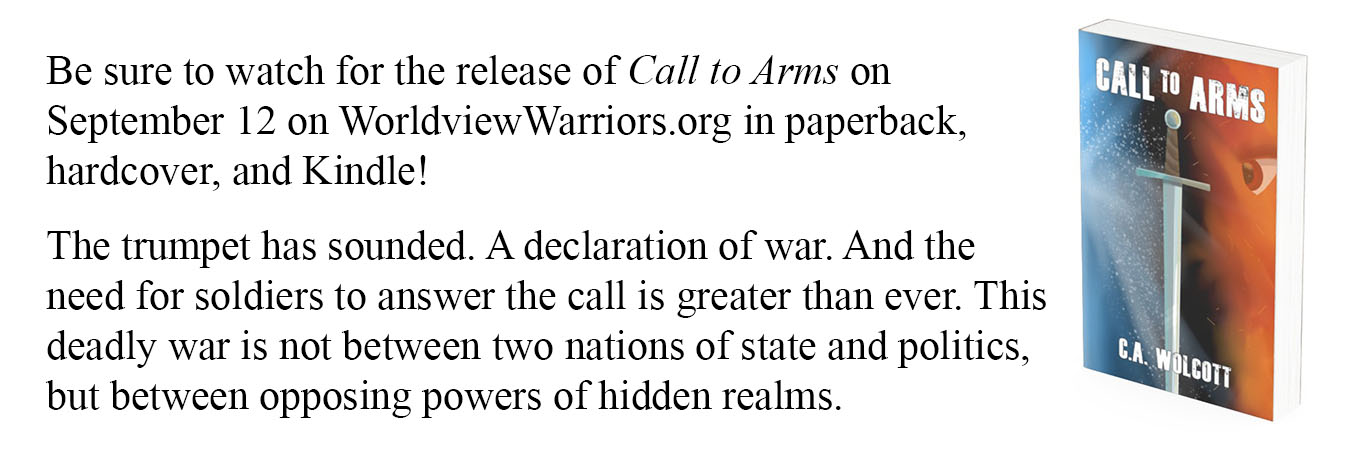
Call to Arms releases in just over two weeks. Please check it out and get your copy on September 12 in paperback, hardcover, or Kindle. The story is engaging and compelling, and you will not want to put it down.
This forum is meant to foster discussion and allow for differing viewpoints to be explored with equal and respectful consideration. All comments are moderated and any foul language or threatening/abusive comments will not be approved. Users who engage in threatening or abusive comments which are physically harmful in nature will be reported to the authorities.
In just a few weeks on September 12, Worldview Warriors Publishing will be releasing our first fiction novel. This will be a reprinting of my novel Call to Arms. With this upcoming release, I am writing two blog posts about this book. This one will give you some of the history of how this book came about. To give the entirety of details here would require several blog posts, but I want to give the highlights.
Call to Arms is a fiction novel that deals with the main theme of spiritual warfare and showcases the reality of it. While the story is made up, there is a lot of truth echoed in this story. I used six actual events that either I experienced personally or I personally knew those involved as key plot points, so I certainly understand the notion of “the truth is stranger than fiction.” The main goal in writing this book is to help train the believer for the reality of spiritual warfare. I will not profess to be an expert on spiritual warfare, but I will proclaim to be a veteran of the war. So here is the story behind Call to Arms.
I began writing this book in April 2007. I had just begun exploring fiction writing, and I had written two novels primarily for practice (no, those are not getting published any time soon). I felt an impression to do this book and to do it immediately. I wanted to wait for more practice before writing it, but there was a sense of urgency with it. So, I started with something, and in six weeks I had 250 pages written. But the whole manuscript was trash in my opinion. The story was okay, but I had a lot of stuff that was definitely less than impressive. So, I took the entire manuscript, took the key characters and key plot points I liked, and re-wrote the whole thing. This version was MUCH better.
It would need a few more drafts and some reworking of some of the plot structure, and I thought I might have something. So, I sent it to a Christian manuscript critique group where professionals would take a few sample chapters and give a thorough critique to see if it is publishable. At first, they said I wasn’t quite ready and to take a creative writing course and/or attend a writer’s conference. I did both. A couple of drafts later, I resubmitted to the same group, and they said it was ready. After a little more feedback, I did need to make a dramatic change to the character and setting structure. It wasn’t as much work as I feared, and it was completely worth it. After seven drafts, I was ready.
As a result of this group’s feedback, they sent my info out to 100 different publishers, mostly of the self-publishing and “pay to publish” types. Several reached out to me but called for a $2000-3000 budget in order to print several hundred books, marketing, etc. I was in college, I was still taking student loans, and I had no real platform either. I wasn’t a speaker or anything, so there was no way I could afford that. But one did reach me, and they only charged enough to do the cover and do the printing. Thus, my first published book Battle Cry: Adventures in the Kingdom of Heaven was born in April 2011. However, this publisher did not do the type of cover I was hoping for, and they did not do a final edit that I thought they would do. People noticed the “Charlie-isms” where I sometimes make the same mistakes or phrase things certain ways.
The next year, I got an opportunity I was not expecting. I got to go to the Colorado Christian Writers Conference, one of the biggest, most well-known, and respected conferences in the nation. I had been wanting to go to for several years, and I ended up going for 6 of the next 7 years and even served as faculty for 4 of those years. It was HUGE, not just numbers wise, but productivity wise. I met a lot of people, got a lot of feedback, got a lot of help in my writing, and better than all that, I met a publisher. This one loved my work, and I wanted something different than what I had, again not knowing much of anything about the industry. They took my manuscript, and I changed publishers. This time, we did a much more thorough editing job, did some minor revisions to clean up the story even more, and they gave me an AWESEOME cover for it. In 2014, this version was released, and Battle Cry became Call to Arms.
Between both publishers, I sold about 500 copies of this book. For the record, that is about the national average, including the mega-sellers and the no-sale books. The responses for Call to Arms were phenomenal. People loved the writing, but they especially loved the story. I set up this book to be a “dual story” novel. I have two stories that run side-by-side: one takes place in the modern day of the mid-2000s. The other takes place in a fantasy setting that reminds readers of Chronicles of Narnia and Frank Peretti’s This Present Darkness. The way the two stories work together has garnered the greatest complements. The next highest category of praise is how well I wrote the sword fights. Being a competitive fencer myself, I had the knowledge to do the sword fights right so the reader is hooked. I not only got endorsements from creation speaker Charles Jackson (check out his Facebook ministry page here) but I also got an big endorsement from Christian fiction blogger Peter Younghusband out of Australia.
But then a problem occurred. I had a trilogy planned. The other two books were written, but when Book 2 was ready to send (Book 3 had a draft done, but wasn’t polished yet), the publisher closed down. It would be several years before I’d hear from them, and trying to reach out garnered no responses. I knew it but the publisher went down and Call to Arms went out of print. By this time, I was fully a part of Worldview Warriors, and we had started our publishing wing. I still know very little about how to go about looking for a publisher, but I didn’t want to ask to see if they would republish it. I would not need ask, however, because Jason DeZurik came to me about it!
I did some more revisions as since its release, I had grown so much doctrinally and in maturity that some things I had written were like, “Yeah, could be better.” But I didn’t make any major changes to the plot. I did change a few scenes while keeping the same plot but made it more plausible. I also decided that I would not complete the trilogy. The plan was for Book 1 to describe the battle between Satan and his minions, Book 2 would describe the battle against the flesh (while also doing the former), and Book 3 would describe the battle against the world’s system. But when I sought to work these two, I lost all interest in doing them. A big part of that is the big plot reveal in Call to Arms. Any sequel I did would have this plot reveal already there and it would never carry the power of the first. So, with this new release Call to Arms will remain a stand-alone novel.
So, in a few weeks, Call to Arms will be re-released for its third edition. It will be my fourth book with Worldview Warriors Publishing. I have two more non-fiction books that are already underway, but I am not done with writing fiction either. I have a big one that has been cooking for a while, and I have some smaller ones that will be fun to do also. When I get to them depends on how much writing time and brain function I have in my off-work hours. Next week, I’ll take a more serious look at spiritual warfare and more of what drove the writing of Call to Arms.
This forum is meant to foster discussion and allow for differing viewpoints to be explored with equal and respectful consideration. All comments are moderated and any foul language or threatening/abusive comments will not be approved. Users who engage in threatening or abusive comments which are physically harmful in nature will be reported to the authorities.
“You have not come to a mountain that can be touched and that is burning with fire; to darkness, gloom and storm; to a trumpet blast or to such a voice speaking words that those who heard it begged that no further word be spoken to them, because they could not bear what was commanded: ‘If even an animal touches the mountain, it must be stoned to death.’ The sight was so terrifying that Moses said, ‘I am trembling with fear.’
But you have come to Mount Zion, to the city of the living God, the heavenly Jerusalem. You have come to thousands upon thousands of angels in joyful assembly, to the church of the firstborn, whose names are written in heaven. You have come to God, the Judge of all, to the spirits of the righteous made perfect, to Jesus the mediator of a new covenant, and to the sprinkled blood that speaks a better word than the blood of Abel.” -Hebrews 12:18-24
In the sections before this in the book of Hebrews, the author has been talking about various aspects of Christian living. So you may be wondering, why is he suddenly talking about mountains? This is another aspect of living the Christian life – he is contrasting the Jewish life, represented by God giving the Israelites the law on Mt Sinai, with the Christian life, represented by Mt Zion.
The author does not specifically mention Mt Sinai, but it is clear in verses 18-19 that this is what is being referred to. We see the fire of God burning on Mt Sinai in Deuteronomy 4:11-13. The things that are mentioned in these verses can all refer to the presence God appearing on Earth – fire (Judges 13:20, 1 Kings 18:38), darkness (1 Kings 8:12), storms (Nahum 1:3), and the trumpet (Exodus 19:16-19, Matthew 24:31, 1 Corinthians 15:52, 1 Thessalonians 4:16).
This is not the presence of a calm, gentle God but one that should strike fear and terror into our hearts. The next element we see confirms this – “such a voice speaking words that those who heard it begged that no further word be spoken to them” (verse 19). The people of Israel experienced this in Exodus 20:18-21 and Deuteronomy 5:25-27. The fear of the Lord was so great that the people of Israel simply could not handle it and didn’t not want to hear God’s voice anymore!
Verse 20 provides a quote from Exodus 19:13. The people were so fearful of God and they lived in fear of God’s commandment that anyone (man or beast) who touches the mountain should die. This shows how holy and separate God is from the people. God made the mountain so holy that the people could not even touch it!
In the passage from Exodus 20:18-21 referenced above, the people were terribly afraid of God, but Moses was not afraid to approach God’s presence. But in verse 21, the writer tells us that even Moses was trembling with fear at God’s presence. This is not a direct quote from the Mt Sinai experience that Moses had, but it does happen during the golden calf incident (Deuteronomy 9:19). The author is portraying a situation where God is greatly to be feared – even by Moses, the Old Testament figure who was known to have the closest personal relationship with God (Exodus 33:11)!
But! Verse 22 begins with this strong contrasting conjunction, indicating something completely different is about to be written. We now see the contrast to the great fear of God at Mt Sinai with the great joy of Mt Zion. Mt Zion is one of the hills on which Jerusalem was built, so Zion and Jerusalem are often considered synonymous to each other. This is considered the “home” of God’s people. This is the city where God dwells. This refers back to Hebrews 11:10 where the author refers to “the city with foundations, whose architect and builder is God.” This is a living city, home to the living God. The people have come by the thousands to experience this joyful assembly that takes place in God’s presence! They have come to give God the glory and honor which He is due.
Verses 23-24 continue to list the reasons that the people have come to this holy city. They have come to celebrate the triumphant church, the assembly of those “whose names are written in heaven.” This may refer to the early martyrs of the church, or some scholars believe it refers to angels; we do not know for sure. The people have come to see God, who is the great Judge of all people. He has made the righteous people perfect through the sacrificial death and resurrection of Jesus.
Jesus is that “mediator of a new covenant” which has been thoroughly described earlier in the letter. The blood Jesus was shed as the perfect sacrifice for all people in all times and in all places; Jesus is the only one who could open up the way to having a relationship with God as no mere human could. Abel’s blood is the first human’s blood recorded to be shed in the Scriptures, and the author shows how much greater Jesus’ blood sacrifice was than Abel’s.
This passage shows the great contrasts that happen simultaneously in our relationship with God. We should have great fear and awe of God, knowing that He is sovereign over everything and has the power to strike us down in death. But we also know that we should have great joy in God because of what Jesus has done for us! The God of the Old Testament and Mt Sinai is still the God of the New Testament and Mt Zion. He is still the same God who we worship today, and we are still commanded to fear Him and also experience joy in His presence to give Him glory.
How are you relating to God today? Are you experiencing great fear of God’s awesome power? Or are you rejoicing in His presence? Both are good! We should have balance between those two – being both joyful and fearful of God’s awesomeness all at the same time.

This forum is meant to foster discussion and allow for differing viewpoints to be explored with equal and respectful consideration. All comments are moderated and any foul language or threatening/abusive comments will not be approved. Users who engage in threatening or abusive comments which are physically harmful in nature will be reported to the authorities.
